If you've shopped around for a cheaper phone plan, you've probably run into the term MVNO - usually right before a tiny voice in your head goes "...is that going to be sketchy?"
Short answer: nope. An MVNO is one of the best-kept secrets in wireless, and once you understand how it works, paying full price for a big-carrier plan starts to feel a little silly. Let's break it down.
What MVNO actually stands for
MVNO stands for Mobile Virtual Network Operator. That's a mouthful, so here's the plain version:
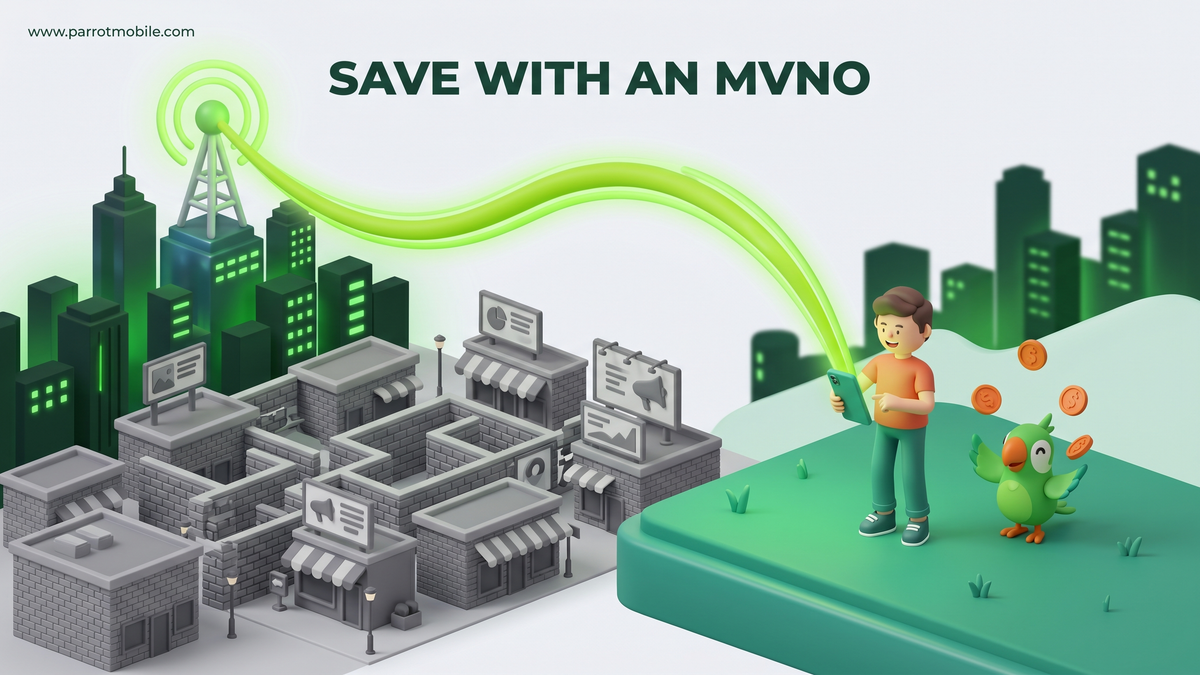
An MVNO is a phone carrier that doesn't build its own cell towers. Instead, it buys access to an existing big network - the same towers, the same 5G, the same coverage - and sells plans on top of it, usually for a lot less money.
Think of it like this: a big carrier built a giant highway. An MVNO pays to put its cars on that highway instead of spending billions to pave its own. Your phone can't tell the difference, because there isn't one. It's the same road.
To take the analogy a step further, imagine renting a luxury apartment. The big carrier owns the entire building, the lobby, the pool, and the gym. They charge premium rent to cover the massive mortgage they took out to build the place. An MVNO comes along, rents a block of apartments at a steep wholesale discount, and sublets them to you. You still get to swim in the exact same pool and use the exact same gym, but you're paying a fraction of the price because the MVNO doesn't have to worry about the building's mortgage.
Imagine paying $100 a month for a gym membership, but you only use the treadmill once a week. The gym also includes a sauna, a juice bar, and free towel service, but you never use them. An MVNO is like a $15/month gym membership that gives you access to the exact same treadmill. You aren't paying for the juice bar you don't use. Big carriers bundle a massive amount of "perks" into their plans-streaming services, cloud storage, international roaming passes-and force you to pay for them whether you want them or not. MVNOs unbundle the service. You pay for the connection, and that's it.
How do MVNOs actually work behind the scenes?
It might sound too good to be true, but the economics are rock solid. Big carriers (often called MNOs, or Mobile Network Operators) spend tens of billions of dollars acquiring radio spectrum licenses from the government and building physical cell towers. Once a tower is built, it costs the carrier roughly the same amount of money to operate whether it's running at 10% capacity or 90% capacity.
The problem for big carriers? They have an enormous amount of excess capacity. If they don't use it, it goes to waste.
Enter the MVNO. The MVNO approaches the big carrier and says, "We'll buy a massive chunk of your unused network capacity at a wholesale rate." The big carrier agrees because it's guaranteed revenue for towers that are already sitting there. The MVNO then packages that capacity into affordable plans and sells them to you.
It's a win-win: the big carrier monetizes its empty network space, the MVNO builds a business without buying real estate, and you get a massive discount on your monthly bill.
So... is the coverage worse?
This is the question everyone asks, and it's a fair one. The answer is no - you get the same coverage as the network the MVNO runs on.
When you make a call or load a video, your phone connects to the exact same towers a full-price customer uses. The signal doesn't know (or care) whether you paid $25 or $90 for your plan.
The towers are identical. What changes is the price - because MVNOs skip the giant retail footprint, glossy ad budgets, and corporate overhead that get baked into big-carrier bills.
There's one bit of fine print worth knowing: during moments of extreme network congestion (think a packed stadium), some MVNO plans can be "deprioritized," meaning full-price customers might get served first for a few seconds. For the vast majority of people, in everyday life, you'll never notice.
The "Deprioritization" Myth vs. Reality
Let's talk about deprioritization, because it's the one thing big carriers use to scare people away from MVNOs.
Networks use a system called QCI (QoS Class Identifier) to manage traffic. Think of it like lanes on a highway. When the highway is completely empty at 2:00 AM, every car goes the speed limit, regardless of what lane they're in.
When the highway is jammed during rush hour, the network has to decide who gets to move first. Postpaid, premium big-carrier customers might get the carpool lane, while MVNO customers are in the standard lanes.
What does this mean for you?
- 99% of the time: You won't notice a thing. Speeds are blazing fast for everyone.
- In a crowded football stadium or a massive music festival: Your data might slow down temporarily. Your text messages and phone calls will still go through instantly, but downloading a 4K video might take a few extra seconds.
Unless you spend your entire life at sold-out Taylor Swift concerts, deprioritization is a non-issue.
Why MVNOs are so much cheaper
Big carriers spend an enormous amount of money on things that have nothing to do with your actual signal:
- Thousands of retail stores: Rent, electricity, and staffing for stores on every corner.
- Massive marketing budgets: Celebrity ad campaigns, Super Bowl commercials, and stadium naming rights.
- Corporate overhead: Armies of executives and massive headquarters.
- Hardware subsidies: "Free" phones that are actually baked into the cost of your bloated monthly plan.
MVNOs cut most of that out. They run lean, sell mostly online, and pass the savings straight to you. Same network, fraction of the price. That's the whole trick.
Big Carriers vs. MVNOs: The Ultimate Comparison
To keep things honest, here's the trade-off table. Let's look at exactly what you're paying for when you choose a big carrier versus an MVNO.
| Feature | Big Carrier (MNO) | MVNO |
|---|---|---|
| Monthly Cost | $70 - $100+ | $10 - $40 |
| Network Coverage | Nationwide 5G & 4G LTE | Same Nationwide 5G & 4G LTE |
| Retail Stores | Thousands of locations | Mostly online (keeps costs low) |
| Phone Subsidies | "Free" phones (with 3-year contracts) | Bring your own phone (unlocked) |
| Network Priority | Highest priority during congestion | Standard priority (rarely noticeable) |
| Extra Perks | Streaming services, cloud storage | Usually none (you buy what you need) |
| Contracts | Often 24-36 month device lock-ins | Month-to-month, cancel anytime |
For most people, that MVNO column is everything that matters and the Big Carrier column is stuff they were never really using anyway. Why pay an extra $60 a month just so a carrier can put their name on a sports arena?
Step-by-Step: How to Switch to an MVNO
Switching to an MVNO is incredibly easy. You don't need to visit a store, and you don't need to be a tech genius. Here is exactly how you do it:
Step 1: Make sure your phone is unlocked
If you bought your phone directly from Apple or Google, it's likely already unlocked. If you bought it from a big carrier on a payment plan, you need to pay it off first. Once it's paid off, ask your carrier to unlock it. You can usually check your unlock status in your phone's settings.
Step 2: Request a Port-Out PIN
If you want to keep your current phone number (and who doesn't?), you need to "port" it. Log into your current carrier's app or website and request a Number Transfer PIN (sometimes called a Port-Out PIN). You'll also need your account number.
Step 3: Pick your MVNO plan
Find an MVNO that fits your needs (like Parrot Mobile!). Choose a plan that matches your actual data usage. Most people use less than 10GB of cellular data a month because they are constantly on Wi-Fi.
Step 4: Activate with an eSIM or Physical SIM
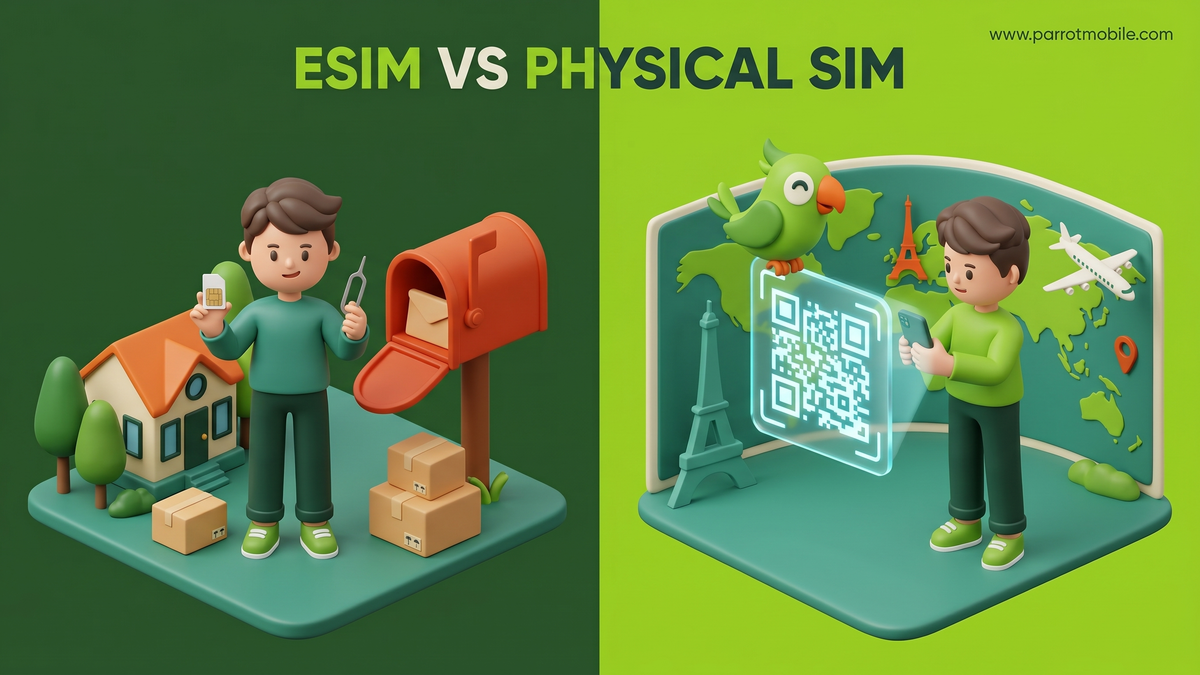
When you sign up, you'll choose how to connect. If your phone supports eSIM (most modern phones do), you'll get a QR code via email. Scan it, and your service is active in minutes. If you prefer a physical SIM, the MVNO will mail you a tiny plastic chip to pop into your phone.
Step 5: Say goodbye to your old carrier
Once your new MVNO service is active and your number has successfully ported over, your old big-carrier plan will automatically cancel itself. You don't even have to call them to break up!
People Also Ask (FAQs)
Will my phone work on an MVNO? Yes! As long as your phone is "unlocked" (meaning it isn't legally tied to a specific carrier's payment plan), it will work perfectly on an MVNO. Modern smartphones are designed to work across all major networks.
Do I lose my phone number if I switch? Absolutely not. By law, you have the right to take your phone number with you to any carrier you choose. The process is called "porting," and it usually takes less than 10 minutes.
Is 5G included with an MVNO? Yes. If the big carrier's network has 5G in your area, and your phone supports 5G, you will get 5G speeds on an MVNO. They use the exact same towers.
Can I bring my family over to an MVNO? Yes! Most MVNOs offer multi-line discounts or family plans. Because the base price is already so low, outfitting a family of four on an MVNO can easily save you over $1,000 a year compared to a big carrier. Managing multiple lines is usually done through a simple online dashboard.
What happens if I travel internationally? This is one area where big carriers and MVNOs differ slightly. Big carriers often include expensive international roaming by default. Many MVNOs offer international roaming as an add-on, meaning you only pay for it when you actually leave the country. Alternatively, you can use a travel eSIM for data when you go abroad, which is almost always cheaper than a carrier's daily roaming pass.
Do MVNOs have customer service? Yes, but it looks different. Instead of driving to a strip mall and waiting in line for 45 minutes to talk to a salesperson, MVNO customer service is typically handled online via chat, email, or phone. Because MVNOs are leaner, their support teams are often more agile and focused on resolving technical issues rather than upselling you on accessories.
What about mobile hotspot and Wi-Fi calling? Almost all modern MVNOs include mobile hotspot capabilities and Wi-Fi calling at no extra charge. It functions exactly the same as it does on a big carrier.
Are MVNOs safe and reliable? 100%. MVNOs are heavily regulated telecom companies. Your calls, texts, and data are routed through the exact same secure, encrypted infrastructure as the major networks.
Where Parrot Mobile fits in
We're an MVNO, and proud of it. Parrot Mobile runs on a major US 5G network, so you get nationwide coverage - but our plans start at $6/month because we're not paying for a mall kiosk in every city.
We also offer a massive Phone Number Marketplace where you can buy premium and vanity numbers to bring with you to your new plan. Curious if your current number spells something cool? Check out our free Phone Number Decoder tool! you get nationwide coverage - but our plans start at $6/month because we're not paying for a mall kiosk in every city.
If you've been hesitant to switch away from a big carrier because you're worried about coverage, this is the part where you can relax. You're getting the same network. You're just keeping more of your money. Take a peek at our plans or check coverage in your area to see for yourself.
The bottom line: an MVNO isn't a downgrade. It's the same wireless service with the marketing budget removed. Make the switch, keep your number, and start spending your money on things that actually matter.