Picture it: you've finally decided to ditch the carrier that's been quietly overcharging you for years. You pick a new plan, you're feeling great, and then a tiny gremlin of doubt shows up. "Wait... what happens to my number? The one that's on my business cards, my kid's school forms, and roughly 4,000 two-factor login screens?"
Deep breath. Your number is coming with you. That handoff has a name - it's called porting - and for the most part it's smooth, boring, and behind-the-scenes. The only real question most people have is the one in the title: how long is this going to take?
The honest answer is "it depends," but not in the annoying way. It depends on exactly two things, and once you understand them you'll know precisely what to expect. So let's demystify the whole thing.
So what is "porting," really?
Porting is just the industry word for moving your existing phone number from your old provider to your new one. Instead of getting assigned some random new digits, you keep the number you already have, and your new carrier does the paperwork to pull it over.
It's not a favor your carrier is doing you, either. Number portability is a right protected by the Federal Communications Commission (FCC). Your old provider legally cannot hold your number hostage, and they can't refuse to release it just because you still owe them money or have an early termination fee floating around (you'll still owe that final bill, but the number goes free).
If you want the nuts-and-bolts, click-by-click version of switching, we wrote a whole walkthrough on that: How to Switch Carriers and Keep Your Number. This article is the companion piece - it's all about timing and what's happening under the hood while you wait.
The two things that decide your timeline
Here's the whole secret. Porting speed comes down to:
- What kind of number you're moving (a cell number? a home phone? an internet-based VoIP line?)
- How well your details match what your old provider has on file.
Nail both and your port can be shockingly fast. Fumble either one and you're in for a wait. Everything else in this guide is really just a deeper look at those two levers.
Let's start with the fun one, because it's the difference between "done before your coffee's cold" and "done sometime next week."
How long porting actually takes, by number type
Not all phone numbers are built the same, and the porting system treats them very differently. Cell numbers zip across almost instantly. Anything that started life as a home phone or an internet line has to take the scenic route.
Here's the quick lay of the land:
| Where your number is coming from | Typical time to port |
|---|---|
| Another mobile carrier | Minutes to a few hours |
| A VoIP provider (Google Voice, Vonage, RingCentral, OpenPhone, etc.) | 3-7 business days |
| A traditional landline | 5-10 business days |
| A toll-free number | 1-2+ weeks |
A couple of things worth tattooing on your brain before you read those numbers too literally:
- These are business days. Weekends and holidays don't count. A port kicked off Friday afternoon isn't "stuck" if nothing moves until Monday - the clock simply wasn't running.
- Your old service keeps working the entire time. There's no dead zone where you're unreachable. Calls, texts, and those precious login codes all keep flowing on your old line right up until the moment the number lands on your new one.
Mobile to mobile: the easy button
If you're coming from another cell carrier, congratulations - you drew the short straw in the best possible way. Mobile-to-mobile transfers are what the FCC calls a "simple port," and the rules say they have to be completed within one business day. In practice, they're usually done in minutes to a couple of hours.
This is also where being on a modern carrier pays off. Parrot Mobile is an MVNO built on top of a major nationwide network, so mobile-to-mobile ports move quickly on our end - often same-day, especially if you're activating on an eSIM and don't have to wait for anything in the mail.
VoIP and landline: the scenic route
Now for the plot twist that trips up so many people. If your number lives with a VoIP provider (think Google Voice, a work softphone, or any "phone number over the internet" service) or a good old landline, the transfer is classified as a wireline port. Wireline ports move through an older, more manual system, and the FCC gives carriers up to four business days for these - but real-world coordination between the two companies often stretches it to a week or so.
This is completely normal. Your VoIP number isn't broken and nobody dropped the ball. Wireline numbers just carry more baggage and more back-and-forth verification. We'll explain exactly why in the next section, because understanding it makes the wait way less mysterious (and less stressful).
Wait, why is my VoIP or landline port so much slower?
Great question, and the answer is refreshingly logical once you see it.
Mobile networks were designed for portability from the start. There's a shared, automated database that carriers use to shuffle cell numbers around, so a mobile-to-mobile move is mostly two computers agreeing on things in near real time.
Wireline numbers (landline and VoIP) live in a different world:
- More manual paperwork. Wireline ports often require a signed authorization form and a copy of a recent bill, and a human on the other end may need to eyeball it.
- Stricter matching. The name, address, and account details have to line up precisely with the old provider's records. VoIP accounts especially are notorious for having a slightly-off billing name or an address you forgot you entered three years ago.
- Two companies on different schedules. A port is a coordinated handoff. If your old provider's porting team only processes requests in batches, you move at their pace, not yours.
None of this is a red flag. It's just the tax you pay for the flexibility of an internet-based or landline number. The good news: once the request is accepted, the finish line is close, even if it doesn't feel like it.
The part everyone gets confused about: "approved" but still pending
This one deserves its own section, because it's the single most common porting question our support team hears.
Here's the scenario. You call your old VoIP provider, and they cheerfully tell you the port has been approved. You check your new account and it says something like pending or in progress. Panic sets in. Approved and pending at the same time? Did something break?
Nope. This is porting working exactly as designed. Let's walk the number through its whole journey so it makes sense:
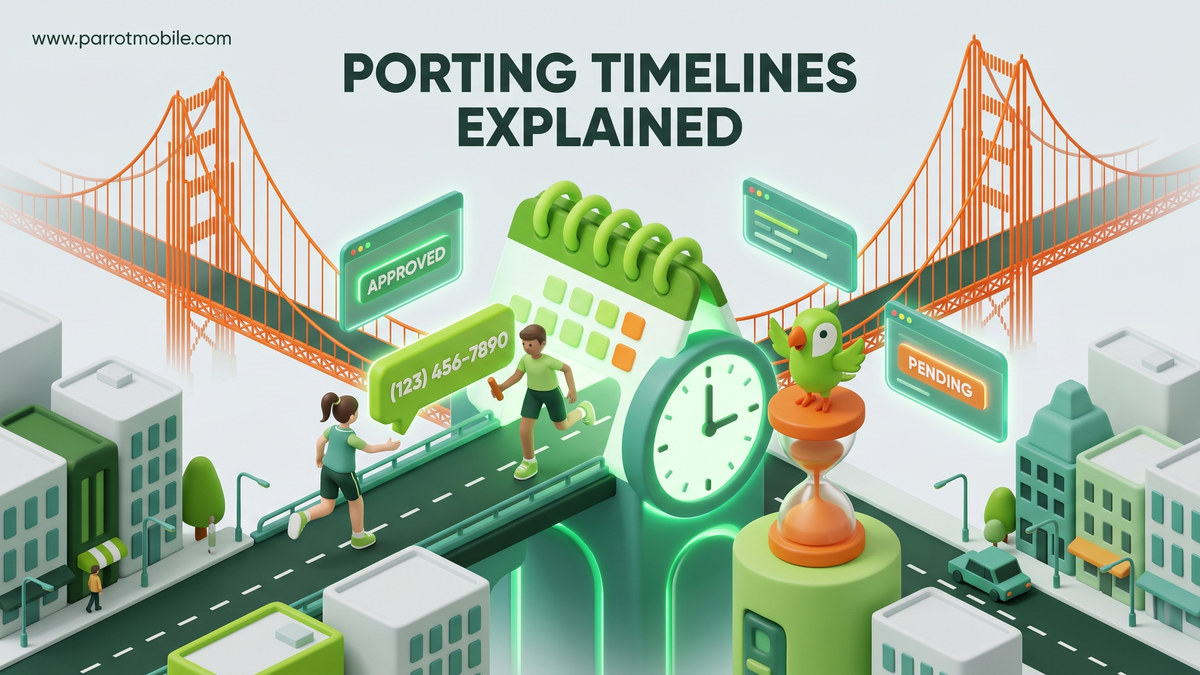
- Submitted. Your new carrier sends the port request to your old one with all your details.
- Validation. The old provider checks that everything matches. This is where mismatched info causes rejections (more on that below).
- Accepted and scheduled. The old provider approves the request and, ideally, commits to a cutover date. In the industry this date is called the FOC - the Firm Order Commitment. It's essentially the old carrier saying, "Yep, we'll hand the number over at this time."
- Cutover. On the scheduled moment, the number physically moves to the new network. Your old line goes dark, your new one lights up.
- Complete. You're fully on your new carrier. Done.
So "approved but pending" simply means you're sitting between steps 3 and 4. The port is locked in and going to happen - it just hasn't hit its cutover moment yet.
The FOC wrinkle with VoIP: Mobile ports usually come with a nice, precise FOC time. Many VoIP providers, though, don't return a firm cutover date at all - they approve the port and then process the actual switch on their own internal schedule. That's why, when a customer asks us for an exact hour, the truthful answer is often "it's approved and we're just waiting on your old provider's cutover, which typically takes a few business days." It's not a stall - there's genuinely no firm timestamp to give until the old side moves.
The reassuring part: throughout all five steps, your old service keeps working. "Pending" is a waiting room, not an outage.
What you'll need to have handy
Since matching details is half the battle, gather these before you start. It's a five-minute job that prevents the vast majority of delays. (Already know your number is portable? Start the transfer and have these ready for checkout.)
- The phone number you're transferring (seems obvious, but people mistype it).
- Your account number with the old provider. It's usually on your bill, and it's almost never the same as your phone number.
- Your Transfer PIN / port-out PIN. This is a special security code, and it is NOT your voicemail PIN or your app login password. Most carriers let you generate one in their app or by texting a short code. It also tends to expire after a few days, so grab it close to when you'll actually port.
- The billing ZIP code, name, and address exactly as they appear on the old account. "Exactly" is doing a lot of work in that sentence - apartment numbers and abbreviations matter.
- A recent bill (and sometimes a signed authorization form). This one is mostly for VoIP and landline ports, where the old provider wants proof before releasing the number.
Pro tip: if you're leaving a family plan and you're not the primary account holder, you'll need the primary person's account number and billing details, and they may need to generate the Transfer PIN for you. Bribe them with coffee.
Why ports get delayed (and how to dodge it)
Remember, roughly 99% of porting hiccups aren't technical failures - they're paperwork. Here are the usual suspects:
- A detail doesn't match. One transposed digit in the account number, a nickname instead of your legal name, or an old billing address will get the request bounced. Fix the typo and resubmit.
- An expired Transfer PIN. These have a short shelf life. If yours aged out, generate a fresh one.
- The account isn't active. A line that's suspended or (worst case) already cancelled is very hard to port. Keep the old service alive and paid up until the move finishes.
- It's a "complex" port. Bundled numbers, business lines, or numbers tied to extra features can get flagged as complex and take longer. If you only want to move one number off a multi-line account, ask your old provider how to unbundle it first.
When a port stalls, your new carrier will let you know what's wrong. Usually it's a quick correction, not a dead end.
The golden rules of porting
If you remember nothing else, remember these:
- Do NOT cancel your old service early. Let the port complete first. Canceling ahead of time can dump your number back into the public pool, and getting it back ranges from painful to impossible. When the port finishes, your old account closes automatically - you don't have to lift a finger.
- Keep the old line active and in good standing until you get the "you're all set" confirmation.
- Respond quickly to any verification request from either carrier. A port waiting on you is the easiest kind of delay to avoid.
- You can't be refused over a balance. Per the FCC, your old carrier must release your number even if you owe them money. (You'll still get a final bill - the number just isn't held hostage.)
People also ask
Can I use my phone while my number is porting? Yes. Your old service stays fully functional - calls, texts, data - right up until the cutover. You won't notice anything until the moment the number switches over.
Will there be a gap where I have no service? For a clean mobile-to-mobile port, essentially no - it's near-instant. For VoIP and landline ports there can be a brief window around the cutover, which is exactly why you keep the old line active until you've confirmed the new one is working.
Is every number portable? Almost always, as long as you're staying in the same general geographic area. The main exceptions are moving to a region your new carrier doesn't serve, or the rare rural wireline provider that has an FCC waiver. If you hit that wall, your state public utilities commission can help.
Does porting cost anything? The FCC bars carriers from charging a dedicated "porting fee," and Parrot Mobile doesn't charge to bring your number in. You are still on the hook for any leftover balance or device payments on the old account, though.
Why does my VoIP port say approved but it's still not done? Because "approved" means scheduled, not finished. The number is locked in for a cutover that your old VoIP provider handles on their own timeline - often without giving a firm timestamp - so a few business days of waiting after approval is normal and expected. See the section above for the full play-by-play.
Can I port a fancy or vanity number? Absolutely, and the process is the same. If you're bringing (or shopping for) a custom number, our Ultimate Guide to Buying a Premium Phone Number covers it.
Ready to bring your number home?
Here's the short version of everything above: your number is portable, your old service keeps working while you wait, and the only real variable is whether you're coming from a mobile carrier (fast) or a VoIP/landline line (a few patient business days).
When you're ready, we've made our end painless:
- Check if your number can transfer - drop it in and we'll tell you instantly whether it's eligible.
- Pick a plan - your number is already attached, so just choose what fits and continue to checkout.
- Enter your account number, Transfer PIN, and billing ZIP at checkout. Our system kicks off the request with your old provider right away.
If you're bringing your own eSIM-compatible phone, a mobile-to-mobile move is often done the same day. Once we email you the all-clear, you activate your line, and that's it - same number, much smaller bill. Welcome to the flock.