Ever glanced at the keypad in your phone app and wondered why the letters are
still there? We type on full keyboards and tap names from our contacts - nobody
"dials" JKL-MNO anymore. Yet those little letters are hiding a fun secret:
every phone number spells something. 🦜
You already know the famous ones - 1-800-FLOWERS, the pizza place with the jingle you can't unhear. But what about the number in your pocket right now? The one you've had since high school? There's a good chance it spells a word, a phrase, or a gloriously weird anagram you've never noticed.
Let's unpack where those keypad letters came from, why our brains love them, and how to find out what your own digits spell.
The surprising history of letters on the keypad
The letters weren't added so we could text someday. They were there from the start to solve a very human problem: nobody could remember seven random numbers.
In the 1920s and '30s, as phone networks spread across the US, the Bell System
introduced the "2L-5N" system - two letters, then five numbers. Your number
started with the first two letters of your local exchange name. Live in the
Pennsylvania exchange? Your number might be PE6-5000 (yes, the one from the
Glenn Miller song "PEnnsylvania 6-5000"). To dial it on a rotary phone, you
literally spun the dial to the numbers under P and E.
It was charming and gave numbers a sense of place. But as the population boomed, the system ran out of memorable exchange names, and by the 1960s the industry switched to plain "All-Number Calling." People genuinely hated it - there were protests and "Anti-Digit Dialing Leagues." Progress won, the numbers stayed, but the letters never left the keypad. They sat dormant until vanity 1-800 numbers and T9 texting brought them roaring back.
Why your brain loves a number that spells something
Why is 1-800-CONTACTS so much easier to remember than 1-800-266-8228? A few quirks of human memory are working in your favor:
- The magic number seven. Psychologist George Miller famously found our short-term memory holds only about seven items at once - roughly the length of a phone number. Push past that and it slips away the moment you're distracted.
- Chunking. Your brain doesn't store
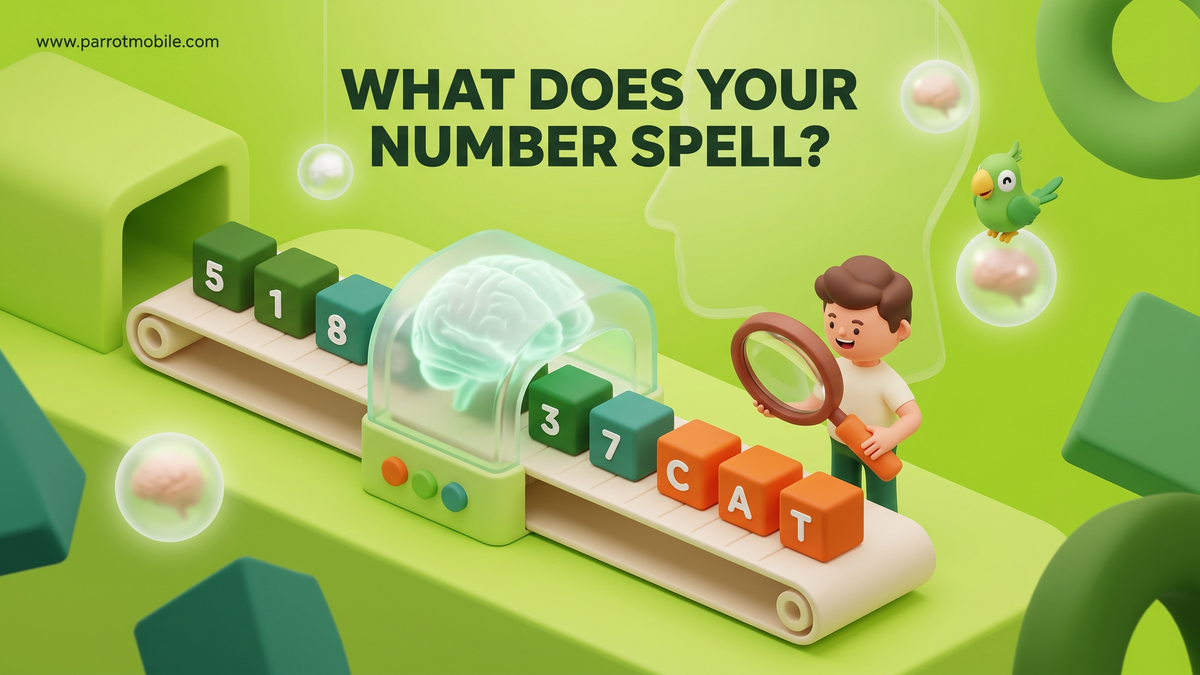
C-A-Tas three letters; it stores "CAT" as one idea. Turn seven digits into a word and you've compressed seven things into one. You just hacked your own memory. - It stands out. In a sea of identical-looking number strings, a word jumps out. We're wired to notice the thing that breaks the pattern.
- It means something. Numbers are abstract; words paint a picture. You can see a roof in "NEW-ROOF" or flowers in "FLOWERS," and that mental image gives the memory extra hooks to hang on.
This is exactly why businesses pay real money for the right number. A memorable, relevant vanity number can lift response to an ad noticeably compared to a forgettable string of digits - the easier you are to remember, the more people actually call.
It's not just for big brands
Vanity numbers built empires - 1-800-FLOWERS, 1-800-GOT-JUNK, and the legendary
1-800-MATTRES ("leave off the last S for savings!"). But you don't need a
national ad budget to play. Real estate agents grab numbers that spell SELL,
dog walkers hunt for BARK, and plenty of people just want digits that spell
their name or something that makes them grin.
So what does your number spell?
Every key (except 1 and 0) maps to three or four letters:
| Key | Letters |
|---|---|
| 2 | A B C |
| 3 | D E F |
| 4 | G H I |
| 5 | J K L |
| 6 | M N O |
| 7 | P Q R S |
| 8 | T U V |
| 9 | W X Y Z |
Here's the fun part: a single seven-digit number has thousands of possible
letter combinations, and a full ten-digit number has hundreds of thousands. With
that many permutations, the odds that your number spells something are
genuinely high. Maybe not one perfect word - but a phrase, a mashup, or a
delightfully random HOT-DOGS.
Finding it turns a sterile string of digits into something that's actually yours. Imagine handing out your number as "just dial 555-COOL-CAT," or realizing the number you've had for a decade secretly spells your nickname. Instant icebreaker, and people remember you.
The catch: doing it by hand is brutal
Try to decode a number with a pen and paper and you'll see the problem fast. Take
555-8437: the 5 could be J, K, or L; the 8 could be T, U, or V; and so on
down the line. You'd have to write out every path - JTGDP, JTGDQ, JTGDR...
- and check each one against a dictionary. You might stumble on a three-letter word, but you'll miss all the good long ones.
That's a job for a computer, not a napkin.
People Also Ask (FAQs)
Does the area code count when decoding? It can! Most decoders let you include the area code, which unlocks even more possible words - though many of the cleanest results come from the seven-digit part people actually say out loud.
Why don't 1 and 0 have letters? Historically they were reserved for special functions (operator and long-distance switching), so they were left blank. That's why true vanity numbers are built around the digits 2 through 9.
Can I get a number that spells a specific word? Often, yes - if it's available. That's what a phone number marketplace is for: you search for the word or pattern you want and grab a number that matches.
Does a vanity number cost more to use each month? The number itself is the special part; your monthly service is just your normal plan. With Parrot Mobile, a memorable number rides the same affordable plan as any other line.
Discover your hidden words today
Your phone number is a little piece of telecom history, a memory trick, and quite possibly a secret message you've been carrying around for years. Whether you're hunting for a brandable number or just want a fun party trick, decoding your digits is a blast.
Skip the napkin math. Our decoder instantly scans every possible letter combination of your number and surfaces the real words hiding inside.
Try the Parrot Mobile phone number decoder, type in your digits, and prepare to be surprised. If yours spells something amazing, share it with your friends. 🦜